


AI adoption has become the operating standard of the marketing industry
Marketing in Southeast Asia has moved past the experimental phase of AI. Advanced adopters, (the organisations at Stage 3 (Early Adoption) and Stage 4 (Expansion)), now account for 57% of the market, and 80% of organisations include AI in their marketing plans at a moderate level or higher. Only 4% remain at the Awareness stage. Adoption now functions as the price of entry to the market, no longer a source of advantage for the few. The open question is no longer whether to adopt, but how deeply to integrate.
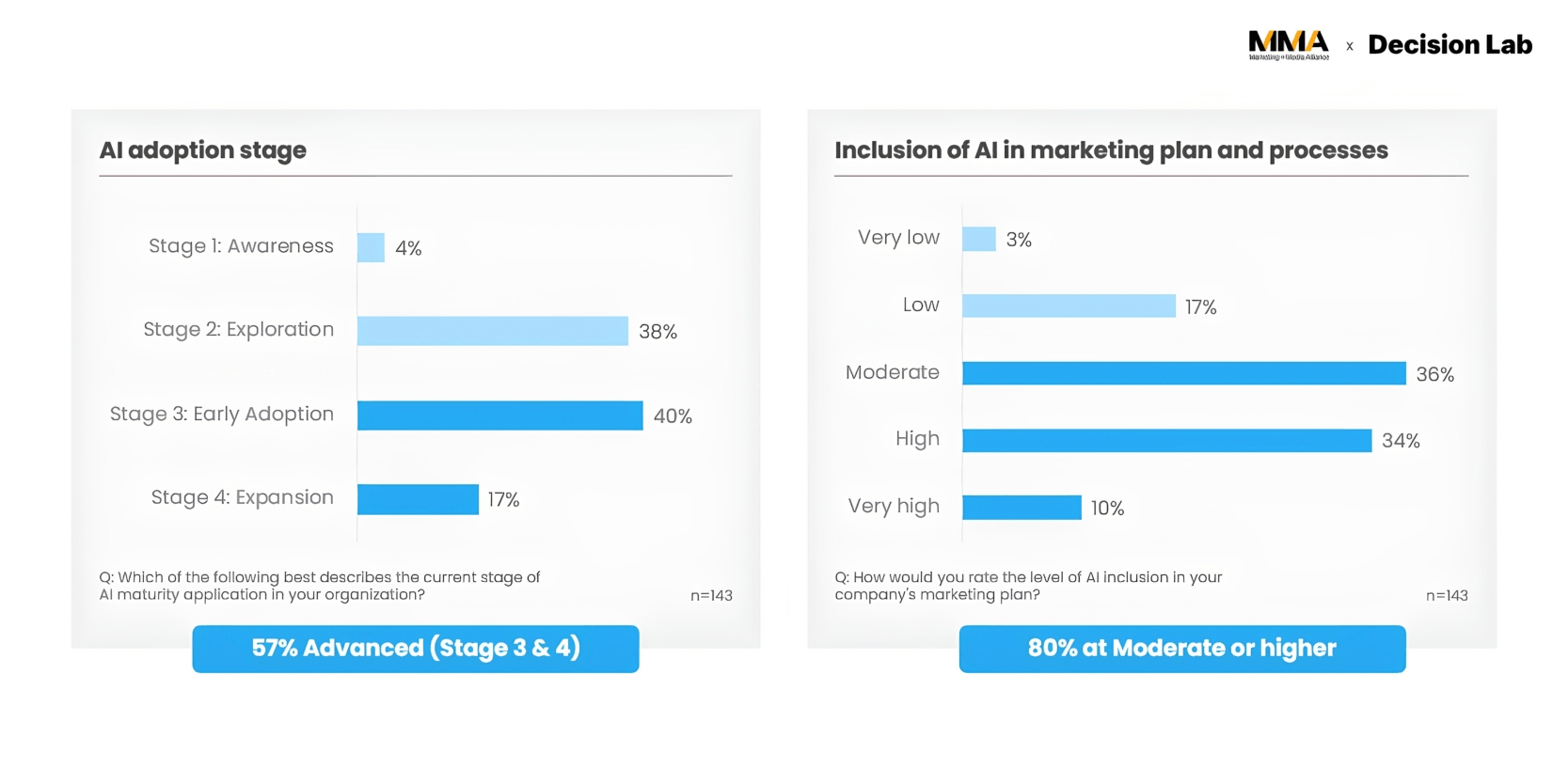
Advanced maturity has become the position of most Southeast Asian marketers,
with 57% of organisations at the two highest stages of the AI maturity journey.
Download the full report at the Decision Lab’s website.
Competitive advantage is built by scaling AI across the full set of marketing functions
Across the region, the advantage of the leaders shows most clearly in how widely they have scaled AI across functions. In content and creative assets, 54% of Advanced organisations have reached scale, against 25% among Early adopters. In customer insights and analytics, Advanced adopters reach 41%, close to double the 21% recorded among Early adopters. Advanced adopters also lead in media allocation and measurement & attribution, reaching 33% and 30% respectively against 10% and 13% among Early adopters.
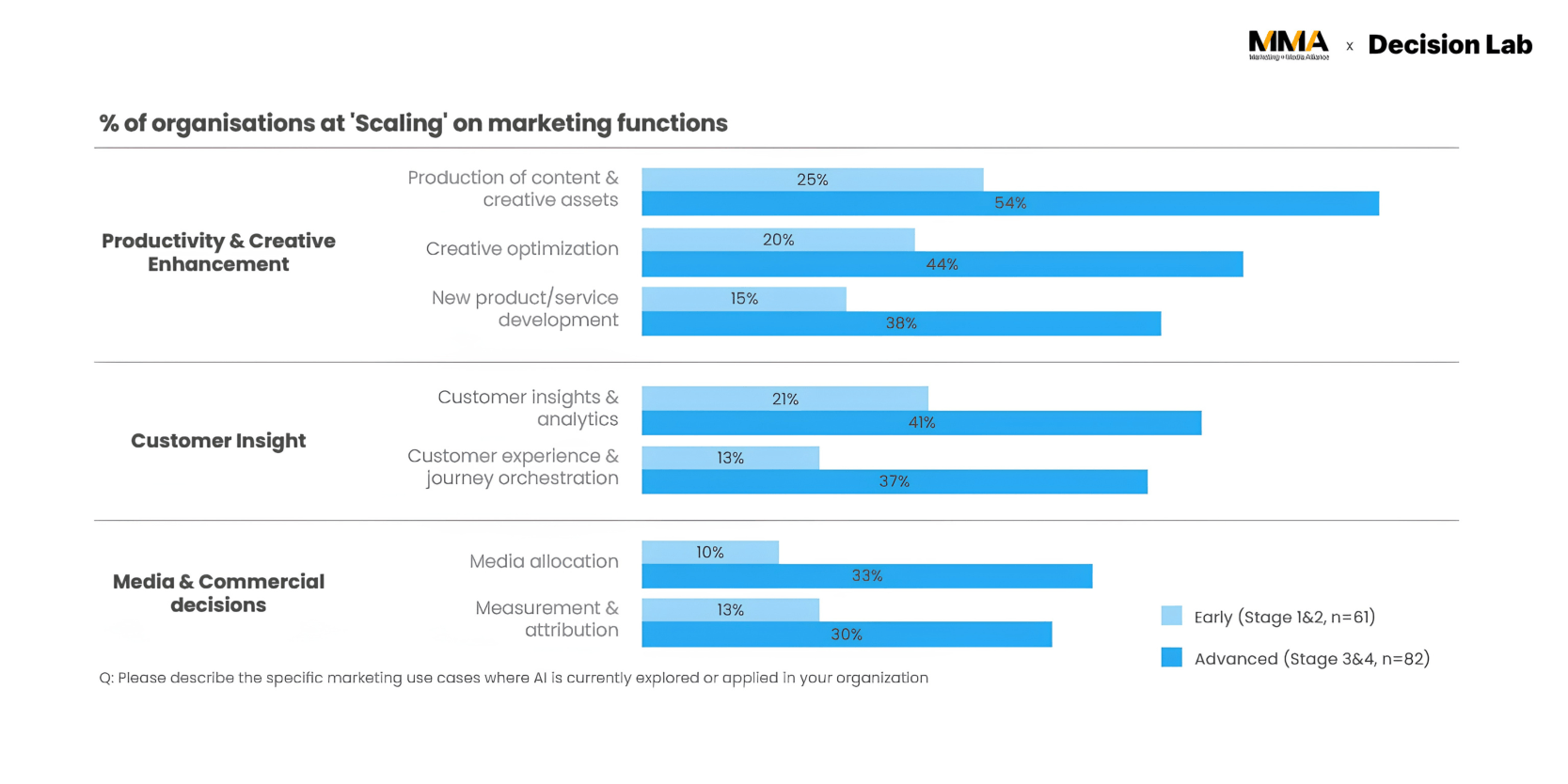
Advanced adopters lead across every marketing function, with the widest relative gap
in media allocation, a function closest to revenue.
What separates the leaders is the number of functions scaled at the same time. Media allocation and measurement are where AI converts into commercial decisions, which is where the advantage of Advanced adopters is hardest to close. Organisations that stop at scaling content are leaving the larger prize in insight and media decisions unclaimed.
Mr Rohit Dadwal, CEO MMA Global Asia Pacific and Global Head of Smarties Worldwide, comments:“This is where Advanced adopters are pulling ahead. Their advantage comes less from owning more tools than from scaled application across use cases, functions, and decision points. They are turning disciplined micro-actions into macro-impact.”
Download the full report at the Decision Lab’s website.
The leaders build team capability and risk governance in step with the pace of AI scaling
The real constraint on the next phase for marketers in the region is organisational capability. Skills and training are the challenge marketers name most often when integrating AI, at 78%, and 34% go further and say AI is not yet effectively understood inside their organisation. Advanced adopters are turning that concern into action, with 63% already running AI training programmes for their marketing teams, against 36% among Early adopters.
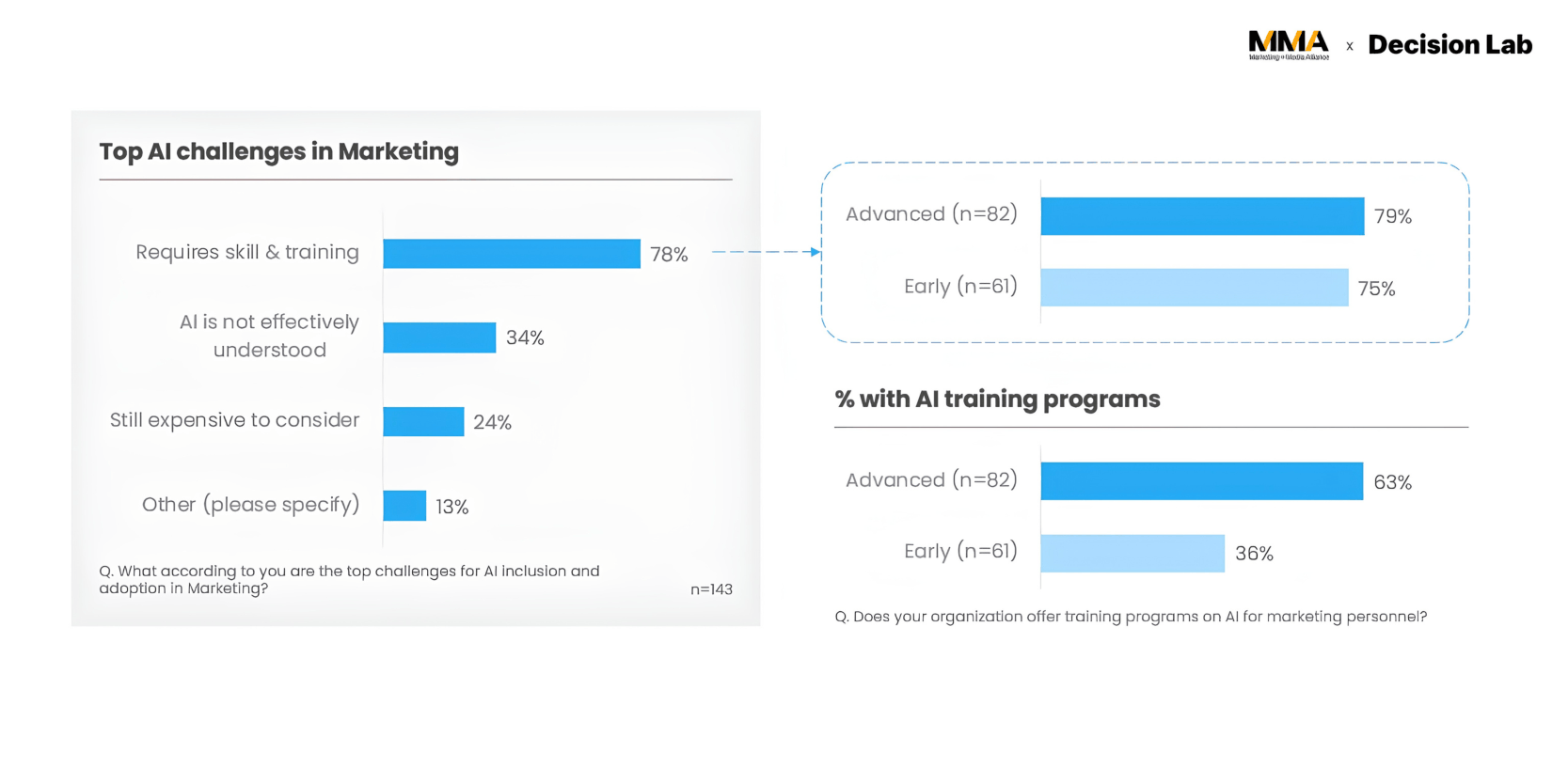
Team capability is the biggest barrier, and Advanced adopters lead by acting on it,
with 63% running AI training programmes against 36% of Early adopters.
Mr Thue Quist Thomasen, CEO of Decision Lab, notes:
“The direction is consistent: integrate AI more deeply than rivals, build proficiency through firsthand practice, and keep your judgement sharp enough to know when to trust the output and when not to.”
Risk governance follows the same pattern. The risk marketers worry about most is data privacy, at 62%, and awareness of the ethical implications of AI reaches 83% among Advanced adopters against 62% among Early adopters. Governance has not kept pace with that awareness, with only 44% of Advanced organisations holding a formal AI risk strategy and the figure falling to 21% among Early adopters. Recognising a risk and being ready to manage it are two different capabilities, and most organisations still hold only the first.
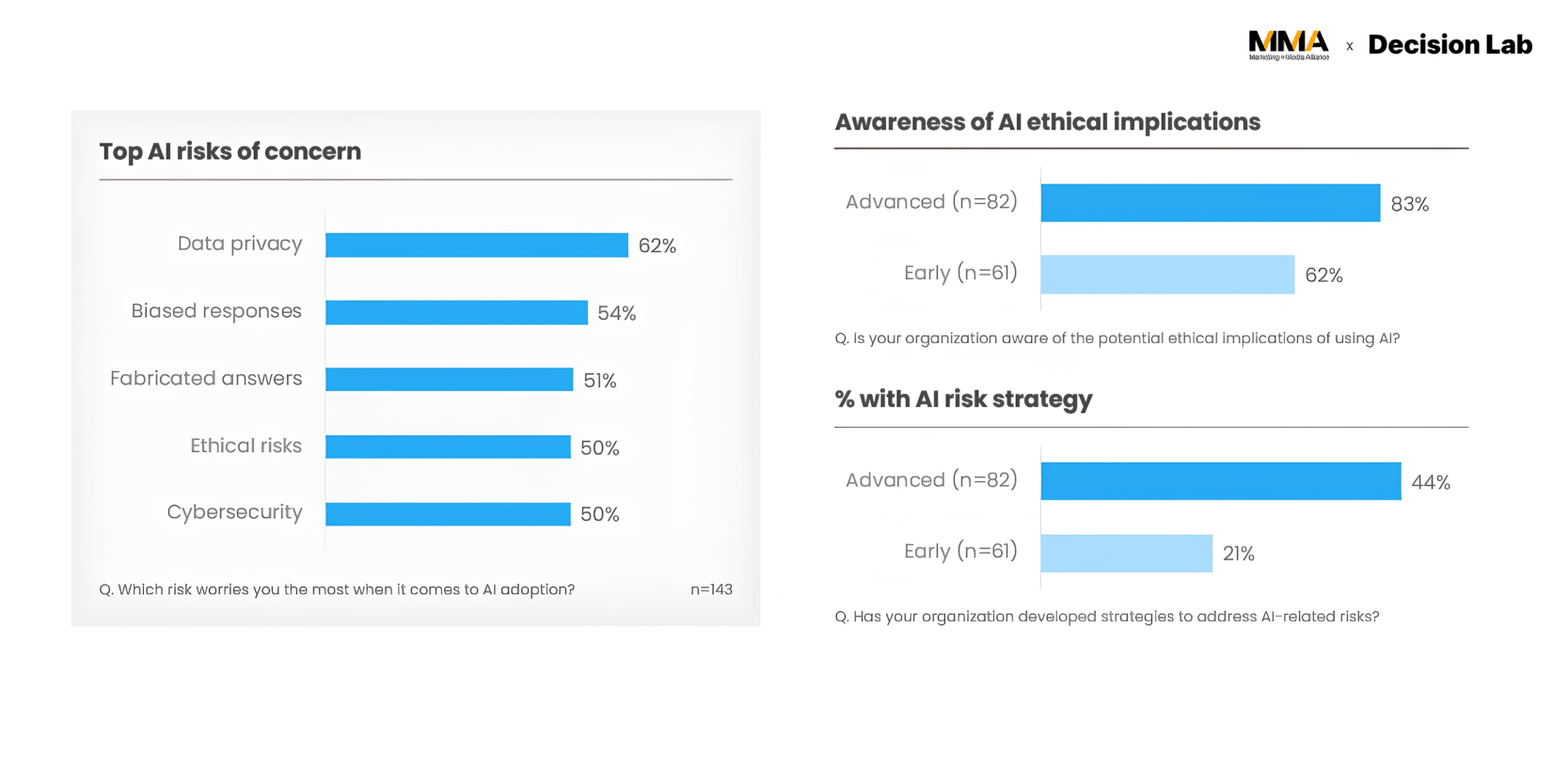
Risk awareness runs ahead of governance, with only 44% of Advanced organisations
holding a formal AI risk strategy against 21% of Early adopters.
Download the full report at the Decision Lab’s website.
Marketing budgets for 2026 point clearly towards AI capability
Investment plans for 2026 show the leaders across Southeast Asia moving to extend their lead. Advanced organisations expecting a budget increase reach 42%, made up of 18% expecting a significant rise and 24% a moderate one, against 29% among Early adopters. Fewer of the leaders plan to hold budgets flat, at 26% among Advanced organisations against 34% among Early adopters.
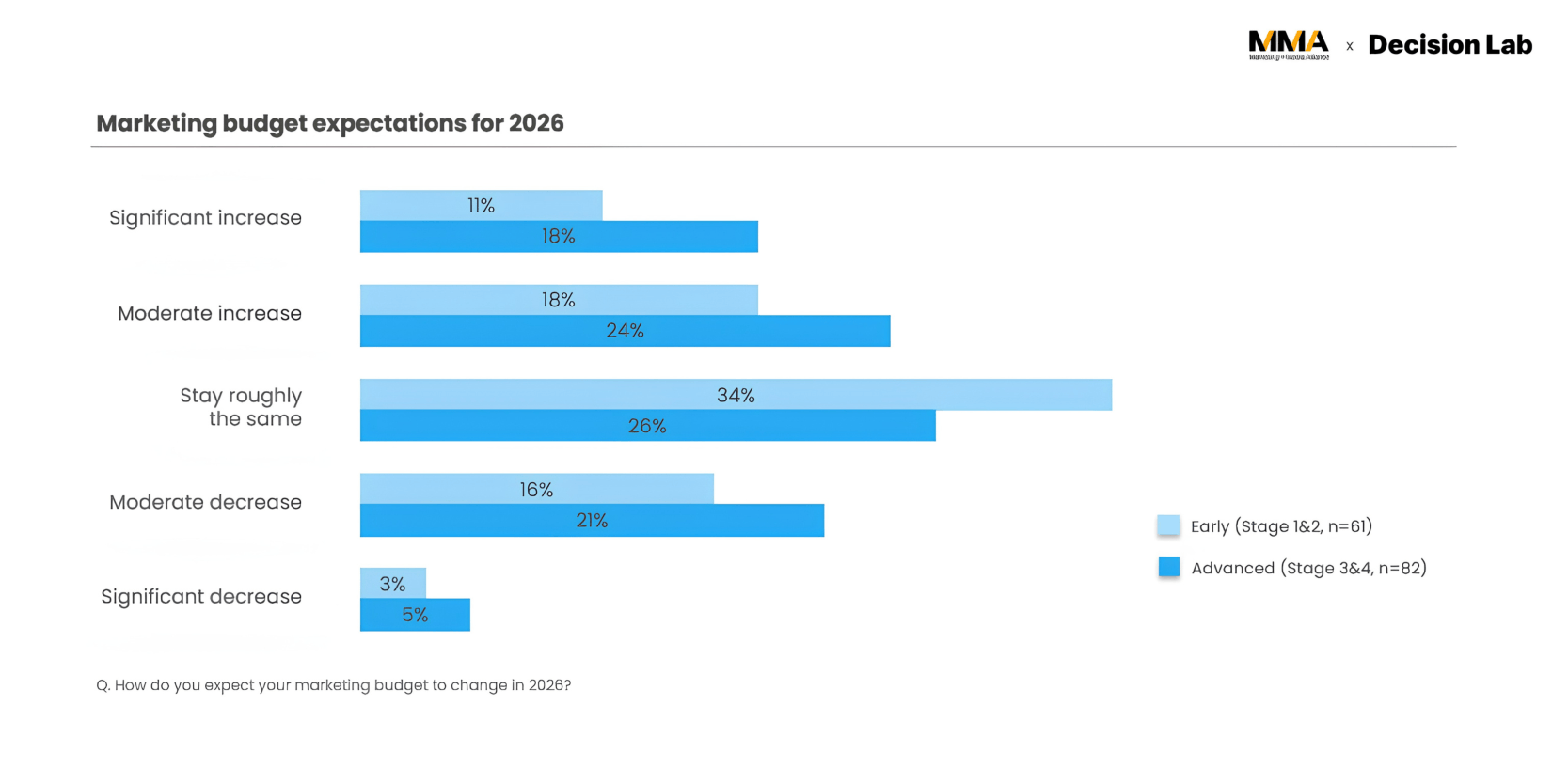
Advanced adopters are reinvesting more heavily, with 42% expecting to
raise their 2026 marketing budget against 29% among Early adopters.
The leaders' expected budget growth gives them greater capacity to reinvest in AI capability, and the gap with organisations holding budgets flat through 2026 may widen further. Adoption has become the baseline across Southeast Asia, and the report points to depth of integration as the factor separating the leaders from the rest.
About Decision Lab
Decision Lab is an insights-driven consulting firm helping organisations succeed in Southeast Asia's next decade of growth. As consumer behaviour, media and technology evolve at unprecedented speed, traditional decision-making models increasingly fall behind. We believe growth only succeeds when decision-making evolves as fast as the market itself. By combining new thinking, emerging technologies and deep local consumer insight, we help leaders turn opportunity into intentional, innovation-led progress, reducing waste, accelerating adaptation and creating lasting commercial impact.
Our work is always decision-focused, guided by five values. Agile, moving quickly to support timely decisions and adapting as priorities change. Ambitious, taking ownership of outcomes and measuring ambition by impact, not activity. Curious, testing relevant tools and methods to reach better answers faster. Rigorous, grounding the work in ethical, well-designed and methodologically sound research. Truth-seeking, communicating insights clearly and directly, honest about uncertainty, so decision-makers understand what the data shows, what it does not, and what it means.
About MMA Global
The Marketing + Media Alliance (MMA) is the global, non-profit community of Chief Marketing Officers and senior marketing leaders advancing marketers’ ability to create value. Led by CMOs and supported by the entire ecosystem at the governance level, including brands, media, agencies, consultancies, AdTech, and MarTech, MMA develops evidence-based models, frameworks, and tools validated through multi-year, multi-million-dollar Think Tanks and Labs.
Operating currently across four global think tanks: Marketing Attribution (MATT), Marketing Org Strategy (MOSTT), AI Leadership (ALTT), Data & CX (DATT), and more to come; MMA tackles marketing’s most challenging unanswered questions and translates findings into applied practices that are guaranteed to increase enterprise value. Headquartered in New York City, with operations in 16 countries across APAC, Europe, MEA, LATAM, and North America, MMA has more than 825 corporate members who gather at 62+ MMA conferences worldwide, and flagship gatherings in the U.S., including MMA’s POSSIBLE in Miami and MMA CMO & CEO Summit in Santa Barbara.