


Vietnam tourism is rising fast but still trails the region
Vietnam is the fastest-improving tourism economy in Southeast Asia. In the World Economic Forum Travel & Tourism Development Index 2026 its score rose 6.3% since 2024, the largest gain in the region, lifting it seven places to 52nd of 110. But speed is not the same as position: even after that climb, Vietnam ranks fifth of the seven Southeast Asian economies in the index, behind Singapore (13th), Indonesia (23rd), Malaysia (26th) and Thailand (38th). Vietnam is improving faster than its neighbours while still competing from behind them, which means the gains are real but the work of catching up has only started.
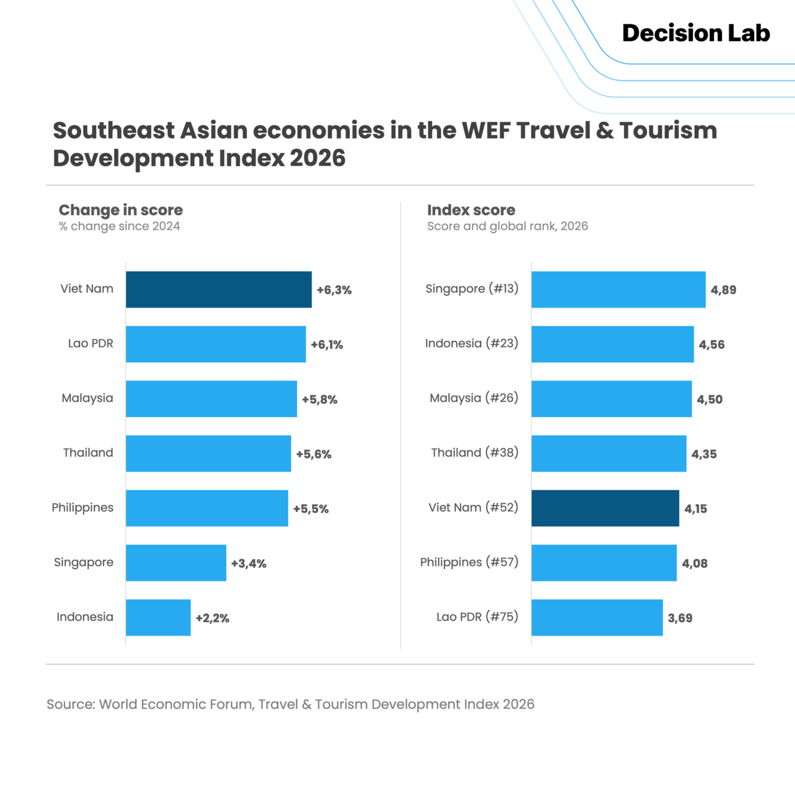
The gap to regional leaders remains wide despite the fastest climb.
That gap is the question this article opens, and the one behind Decision Lab's Travel & Tourism investigation, From arrival to affinity. Rapid growth gives Vietnam real momentum, but momentum is not durability. The index shows why. Vietnam ranks among the strongest in the world on what attracts visitors, 7th of 110 on price and 9th on safety, but far lower on what the trip itself delivers, 74th on tourist services and infrastructure and 106th on socioeconomic impact. In other words, Vietnam is far stronger at attracting visitors than at increasing what each visit is worth. That is both the opportunity and the risk: if Vietnam identifies and fixes where value leaks, fast growth becomes durable growth; if it does not, record arrivals may not translate into the value needed to sustain them.
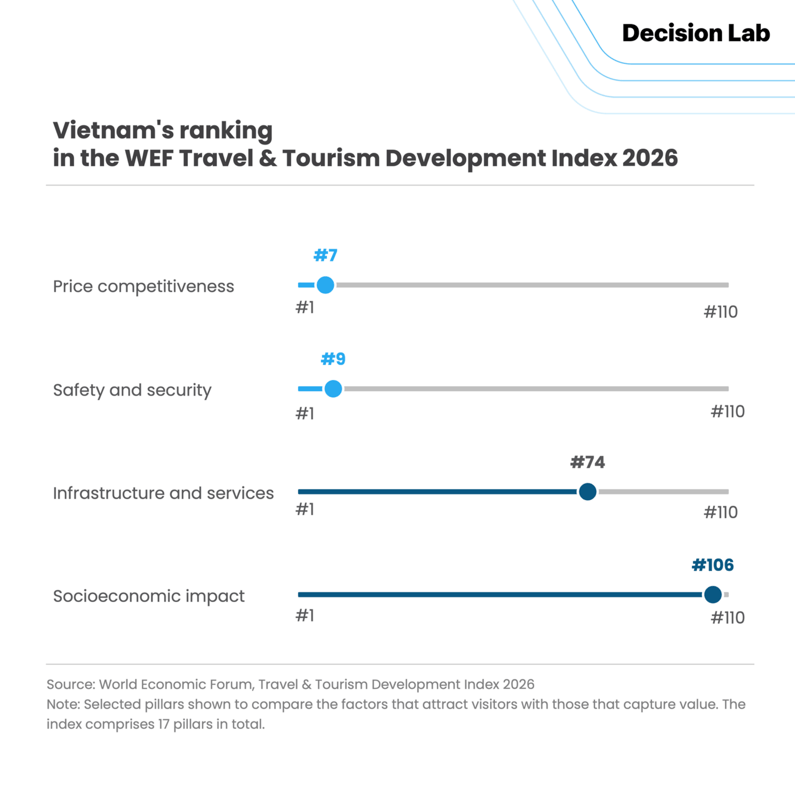
Vietnam competes on access, while the gap is in what the trip delivers.
Growth is shifting towards China and India as established markets soften
This is where growth becomes both an opportunity and a risk. According to Vietnam National Authority of Tourism (2026), international arrivals to Vietnam reached 21.2 million in 2025, up 20.4%, and the first eight months of 2026 added almost 16 million more, 64% of the annual target of 25 million. But the national total hides different market stories: in 2025 arrivals from China grew 41.3% and India 48.9%, while South Korea fell 5.2% and Taiwan 4.4%, two of Vietnam's closest and most familiar markets. Growth that relies on winning new visitors, rather than bringing them back, has to be won again each year. Without a clear view of what makes visitors return and spend more, fast growth today can mask a weaker foundation underneath.
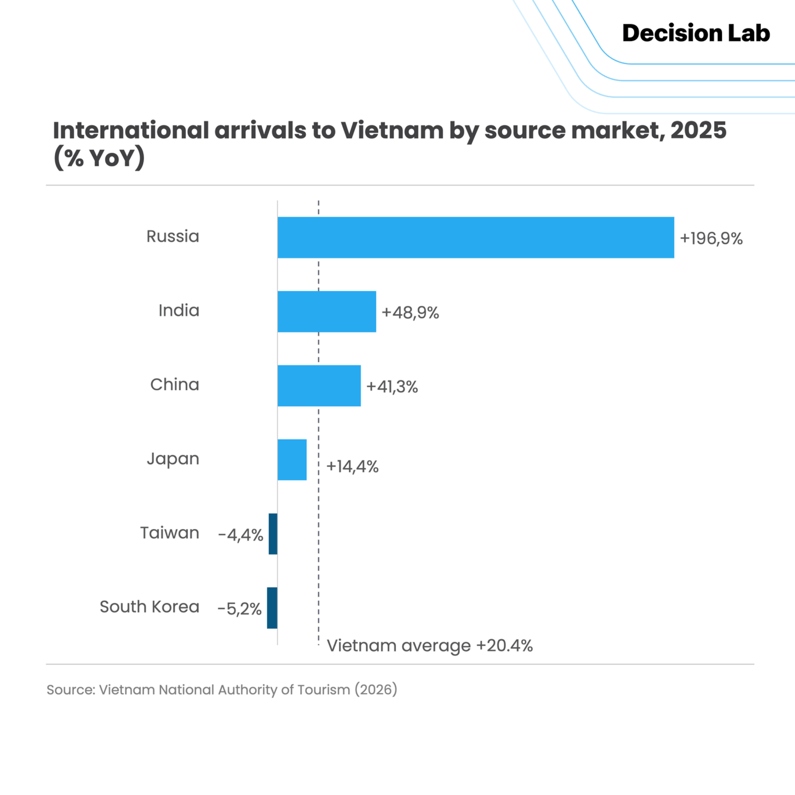
Growth from China and India is offsetting softer demand from established markets.
This is the gap the series investigates: not why visitors come to Vietnam, but whether enough come back, and what would make each visit worth more. The WEF ranking shows the gap exists; it cannot explain what causes it. Is it the experience, the price, the mix of visitors, or something in the journey that stops a first trip becoming a second? The research will trace the full journey, from planning and booking to food, activities and departure, to find which moments drive a visitor to return and spend, which markets behave differently, and which businesses can change the outcome.
Closing the value gap needs evidence from the full visitor journey
Decision Lab’s Experience Economy Practice works with investors, operators and infrastructure providers in Vietnam’s booming tourism economy to help build lasting commercial growth and opportunities.
Public indices can show that the gap exists. They cannot show what closes it. That requires measuring behaviour across the journey: separating what people say from what they do, and correlation from cause. Decision Lab combines consumer panels across Vietnam and the region with work across hospitality, aviation, travel platforms and experience businesses, so the analysis starts from the commercial decisions behind the numbers. We are running this series because the value question will shape Vietnam's next decade of tourism, and it needs evidence, not assumptions.
Vietnam does not have a visitor shortage. The question for 2027 is whether it can turn the fastest growth in the region into lasting value, by turning first-time visitors into ones who return and spend more. Decision Lab’s Experience Economy Practice will in it’s From arrival to affinity investigation deep dive into this key question to support the long term growth of the industry.
If you lead in hospitality, aviation, travel platforms, tourism bodies or experience businesses, we are interested in your perspective. Contact Decision Lab's Head of Experience Economy team to understand how you can take part in email.
Source:
World Economic Forum. Travel & Tourism Development Index 2026. 25 September 2026. https://www.weforum.org/publications/travel-tourism-development-index-2026/
Vietnam National Authority of Tourism. BREAKING NEWS: WEF announces the 2026 Tourism Performance Index ranking, Vietnam rises 7 places. 25 September 2026. https://vietnamtourism.gov.vn/post/68544
Vietnam National Authority of Tourism. International visitor statistics (August 2026 data). https://vietnamtourism.gov.vn/en/statistic/international
Vietnam National Authority of Tourism. Vietnam's tourism sets a new record, ranking among the world's fastest-growing. 8 January 2026. https://vietnamtourism.gov.vn/en/post/21493