

.jpg?width=300&name=obesity%20(1).jpg)
- 83% of respondents recognize obesity as a disease that can cause many chronic diseases, yet early intervention is hindered by normalized sedentary lifestyles, delayed health consequences, and deep-rooted cultural beliefs.
- Stigma and stereotypes remain widespread. Over half still associate obesity with laziness or poor self-discipline - discouraging those affected from seeking treatment.
- An urgent need to raise awareness and reframe obesity as a chronic disease requiring early intervention and coordinated healthcare and policy responses.
Download the full report here.
According to the World Obesity Atlas 20251, Vietnam currently has one of the lowest obesity prevalence in Southeast Asia, but it is rising at the fastest pace in the region. A new public report from Novo Nordisk Vietnam, developed in collaboration with Decision Lab, sheds light on how obesity is perceived in Vietnam and why action remains limited despite rising health and economic risks. Based on survey responses from 1,004 Vietnamese people across five major cities and in-depth interviews with patients and healthcare professionals, the report reveals a striking paradox: awareness is high, yet action is lacking. Delayed consequences, ingrained lifestyle habits, and early-life misconceptions contribute to inaction, while stigma and systemic barriers continue to hinder timely prevention and treatment. The report calls on policymakers, healthcare providers, and communicators to bridge the gap between awareness and action - before obesity becomes an entrenched public health and economic crisis in Vietnam.
“This report is a wake-up call,” said Mr. Erik Wiebols, General Manager of Novo Nordisk Vietnam “We must work together to build a supportive ecosystem - one that enables prevention, empowers treatment, and creates a healthier, more inclusive future for all.”
Obesity as a silent epidemic in Vietnam
The World Health Organization (WHO)2 defines obesity is a complex chronic disease and it is becoming an epidemic due to its gradual onset and far-reaching consequences. The rise in obesity not only poses significant threats to individual health, but also places strain on the national economy. The World Obesity Atlas 20233 estimates that the total economic cost related to high BMI of Vietnam will rise from $4 billion in 2020 to over $16 billion by 2035, with healthcare costs alone increasing from $372 million to $1.27 billion. Despite this, Vietnam ranks only 108th out of 183 countries in obesity treatment preparedness, highlighting critical gaps in public health infrastructure and coordinated response.
Widespread awareness vs. persistent stigma
The study found that 83% of respondents recognize obesity as a disease linked to chronic illnesses such as lipid disorders, heart disease, and diabetes, with 72% also citing risks of cancer and infertility. Most also see its impact on daily life, from lower self-confidence (82%), poorer mental health (80%), reduced work performance (80%) or even strained relationships (60%).
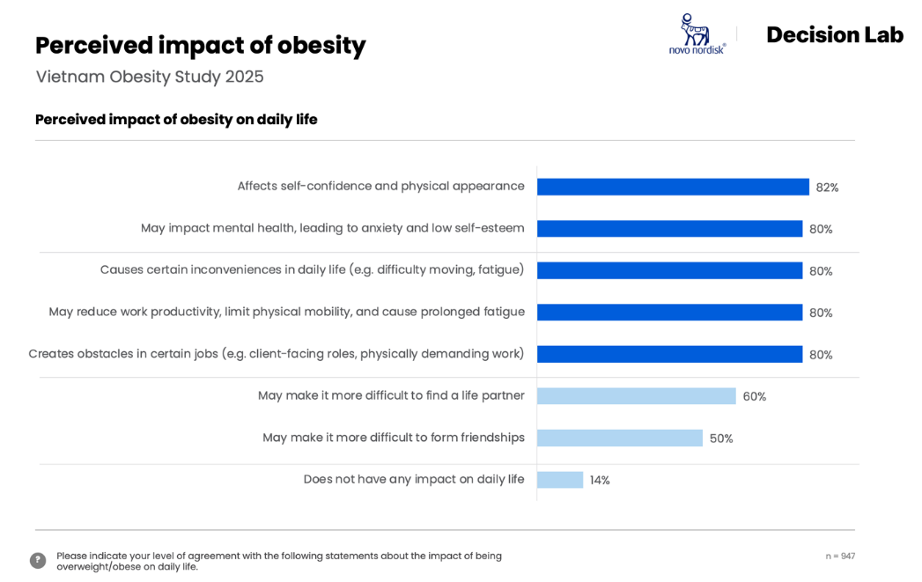
Yet this awareness coexists with persistent stigma and negative stereotypes. For example, nearly 8 in 10 also believe people with obesity are disadvantaged in jobs where appearance is valued. More than half still attribute obesity to laziness or poor self-discipline, reinforcing discrimination in healthcare, education, and the workplace.
Knowledge alone is not driving action
Knowing that obesity is risky does not always lead to action, largely due to three key reasons: modern lifestyles have normalized unhealthy habits, health consequences feel distant, and cultural misconceptions in nutrition persist, especially among parents.
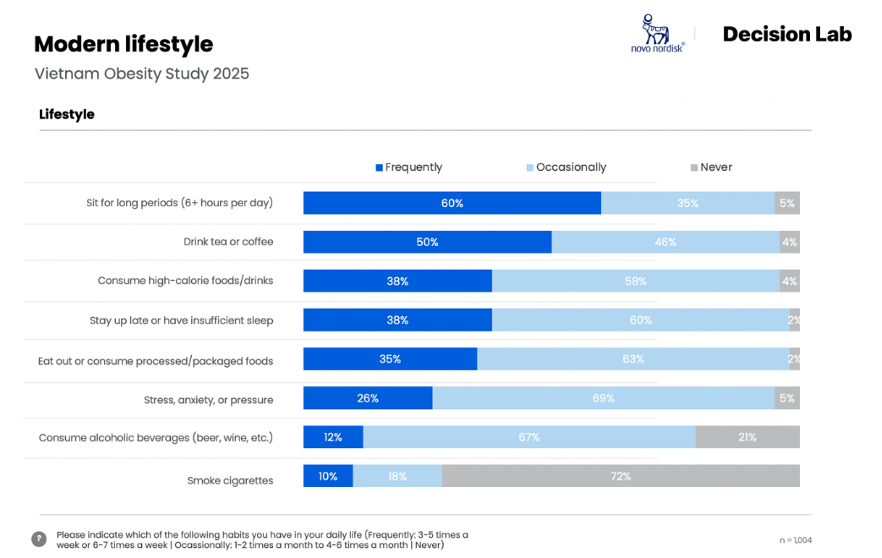
Today, nearly two-thirds of people sit for over six hours a day, and more than one-third regularly consume processed foods. Meanwhile, the slow onset of complications further reduces urgency: the ACTION-Vietnam4 found that 30% of people with obesity are content with their weight, while 36% consider it less concerning than other diseases. Cultural beliefs also play a role, with 55% of parents more worried about picky eating than overfeeding, 42% viewing “chubby children” as healthy, and 37% linking higher food intake with faster growth.
A national call to action
Obesity in Vietnam is no longer a future concern - it has become an urgent and escalating burden that threatens both individual well-being and the nation’s economic stability. To shift the trajectory, the country must reframe obesity as a chronic disease that demands medical, societal, and policy-level responses. The findings from the Vietnam Obesity Study 2025 underscore the critical need to enhance public awareness, while accelerating early intervention, establishing comprehensive treatment strategies, and delivering personalized care pathways for those living with obesity.
As a key partner of the Vietnam Obesity Study 2025, Novo Nordisk is committed to advancing obesity care in Vietnam. This includes raising public awareness, strengthening healthcare provider training, improving access to treatment, and fostering strategic partnerships with the Ministry of Health, medical associations, academic institutions, and hospitals.
About Vietnam Obesity Study 2025
The Vietnam Obesity Study 2025 is a joint initiative by Novo Nordisk and Decision Lab, developed to explore public perceptions, awareness, and attitudes toward obesity in Vietnam. The study integrates quantitative findings from an online survey of 1,004 Vietnamese people across five major cities (Hanoi, Ho Chi Minh, Da Nang, Hai Phong, Can Tho), and qualitative insights from in-depth interviews with individuals living with obesity, parents, and healthcare professionals. In addition, it incorporates secondary data from the ACTION-Vietnam, a non-interventional, cross-sectional survey involving 1,000 people with obesity (PwO) and 200 healthcare professionals (HCPs) across Vietnam.
Download the full report here.
References
1 World Obesity Atlas 2025, World Obesity Federation: https://www.worldobesity.org/resources/resource-library/world-obesity-atlas-2025 (Access on May 2025)
2 Obesity and overweight, WHO, https://www.who.int/news-room/fact-sheets/detail/obesity-and-overweight (Access on May 2025)
3 World Obesity Atlas 2023, World Obesity Federation: https://www.worldobesity.org/resources/resource-library/world-obesity-atlas-2023 (Access on May 2025)
4 Perceptions, Attitudes, Behaviours and Barriers in Obesity Care: Findings from the ACTION-Vietnam Study: Perceptions, Attitudes, Behaviours and Barriers in Obesity Care: Findings from the ACTION - Vietnam Study | Journal of the ASEAN Federation of Endocrine Societies